Meet David Chevalier

David Chevalier | Executive Leadership Coach
I didn’t plan to become a coach. For twenty years I was the one under pressure: handling loans in commercial banking, co-founding an agency where missing payroll was a real possibility, and building a sales team and a CRM at a legal tech company without the business slowing down.
Somewhere along the way, I started noticing something. What was really stuck rarely showed up on a spreadsheet. It was the leader who wasn’t ready to decide. The team leads who wanted different things and had never said so out loud. The manager getting great results while quietly micromanaging. Once I started seeing these patterns, I couldn’t stop.
So I studied them seriously: a master’s in organization development, then Georgetown’s coaching program, then Hogan certification. I wanted more than instinct to explain what I’d been watching for years.
I work with a small number of leaders at a time, on purpose. Many of them look successful from the outside and know, privately, that something needs to shift. I don’t hand them a framework or tell them how to lead. My job is to give them room to think clearly, notice what’s running underneath, and change how they lead, not because a book or a coach told them to, but because they’ve decided it’s time.
Hogan’s assessments help with that. They don’t prescribe a way to lead. They show how others are likely to experience you, which gives us something concrete to think with.
If something needs to shift for you, let’s talk. Book a 15-minute conversation.
Credentials & Certifications
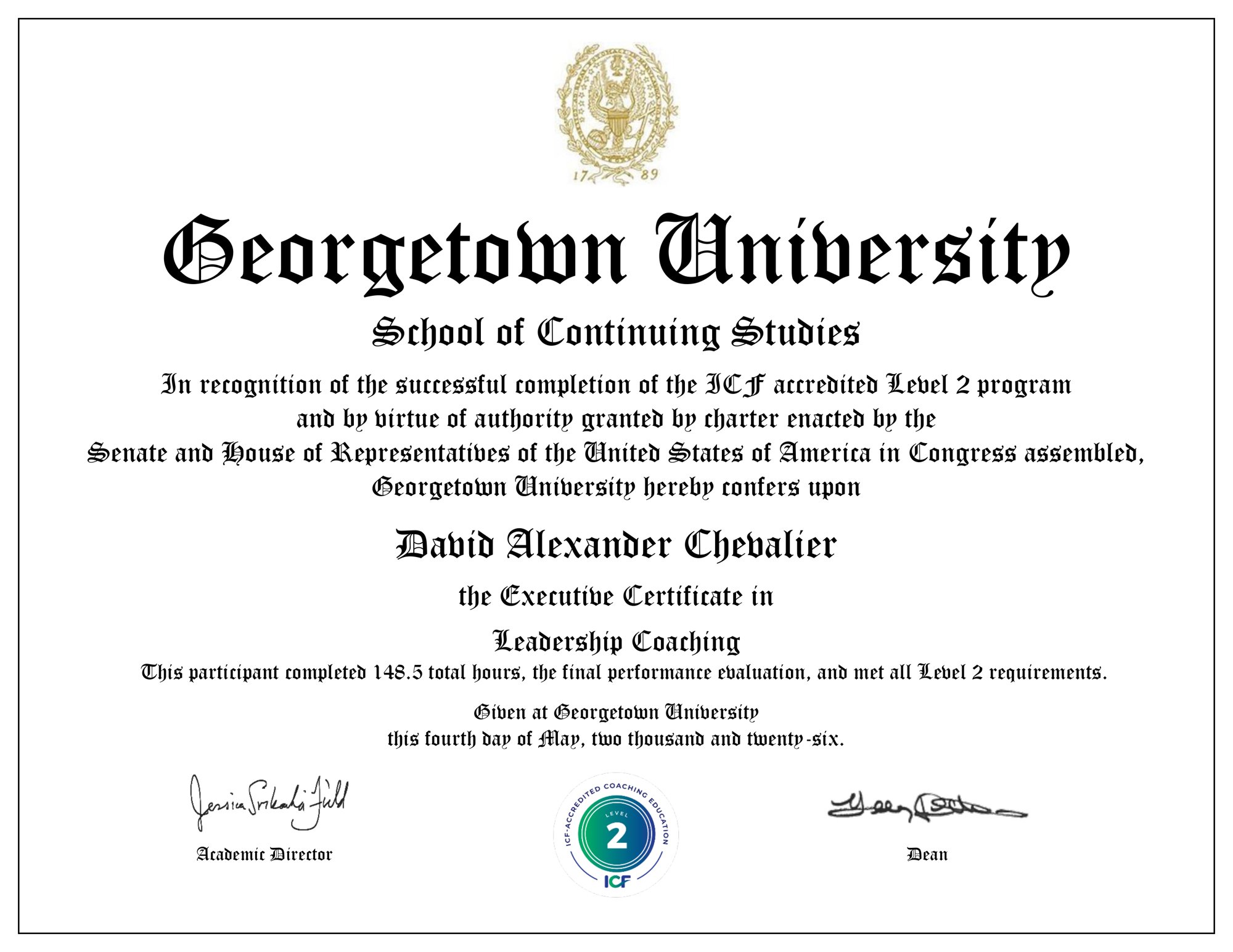
Executive Certificate in Leadership Coaching — Georgetown University, Institute for Transformational Leadership (ICF Level 2 accredited program)
Certified Hogan Assessments Practitioner — HPI, HDS, and MVPI
M.S., Organization Development
VP-level operating experience across commercial banking and financial services.
Who I Work With
Capable people. Leaders who are good at what they do and know it, but who've hit a ceiling that more effort won't solve.
A few patterns show up again and again:
They're still proving themselves through sheer output: answering everything, saying yes to everything, outworking everyone.
They think everything through so thoroughly that decisions stall. The thinking isn't the problem. Deciding is.
They've become the person everything routes through, and haven't noticed they're now the bottleneck.
They've built influence on being liked and being right, and it's starting to cost them.
They solve their team's problems for them, which feels helpful but keeps everyone dependent.
What's Underneath
None of this is a skills gap. These are the exact habits that got them promoted, and now those same habits are the ceiling. A Hogan assessment puts names and evidence to these habits, which is why it's a good place to start.
The Shift
The work is usually one of these, sometimes several at once:
From needing approval to trusting your own judgment.
From overwork to a pace you could sustain for a decade.
From holding onto control to sharing ownership.
From reacting to what's in front of you to designing how things run.
From being the one with the answers to building people who can find their own.
Is This a Fit?
Probably a fit if:
You're leading a team, a function, or a company, and feel the weight of it growing.
You already know working harder isn't the answer.
You're ready to change how you operate, not just talk about it.
Probably not a fit if:
You want a quick tactical fix and would rather skip the part where we look at the patterns.
What you're really after is someone telling you you're doing fine.
You want someone to hand you the answers instead of doing the harder work of finding your own.
If it turns out someone else's approach would serve you better, I'll tell you, and I'll introduce you to someone I trust.
If this sounds like you, book a 20-minute conversation.

Start with a 15-minute conversation.
Explore How Coaching Can Help You